THE HARVARD SCIENCE CENTER TRANSFORMATIONS 1998-2025
Over a period of 25 years, Leers Weinzapfel Associates has led a series of additions, renovations, and transformations for the Harvard Science Center, a modern landmark on Harvard’s campus.
BACKGROUND
The Harvard Science Center, completed in 1972 and opened in 1973, was designed by the Catalan architect Josep Lluis Sert (Sert, Jackson, and Associate) following his tenure as Dean of the Graduate School of Design. It was one of the last buildings Sert designed in Boston following the Holyoke Center (now the Smith Campus Center), Peabody Terrace apartments, both at Harvard, and the Main Library, Student Union, and Law School at Boston University.
As Harvard’s first major facility dedicated to undergraduate science education, the building introduced a bold, modernist presence at the northern edge of Harvard Yard. Sert envisioned the Science Center as both a highly functional academic hub and a civic structure. It merged classrooms, laboratories, and lecture halls into a unified architectural statement rooted in modern materiality and structural expression and illuminated by generous daylight.
Sert designed the Science Center as part of a larger campus plan- connecting Harvard Yard to the growing northern campus through a network of circulation paths. Inside the building, this idea took shape as a crossroad: two intersecting corridors at the center, intended for easy movement and encouraging interaction and a sense of academic community. While Sert’s concept organized circulation and encouraged flow, the emphasis on movement offered few moments for students, faculty, and visitors to pause, connect, or make the space one’s own.
The Science Center was a groundbreaking exploration of expressed structure and building systems. Framed with precast concrete beams with voids for piping and electrical conduit to pass through, it was a model of rigorous construction. The exterior was enclosed with exposed aggregate precast panels, and a syncopated rhythm of windows. Major skylights marked the interior crossroads to emphasize their street like character. Through the years, the material boldness of the building has been appreciated by some but not all. While it is wonderfully light filled, the roughness of interior concrete and exposed mechanical and electrical systems which have grown rapidly in the past 50 years are seen as less welcoming and visually chaotic.
A HISTORY OF TRANSFORMATION: GROWTH AND CHANGE FOR NEW USES
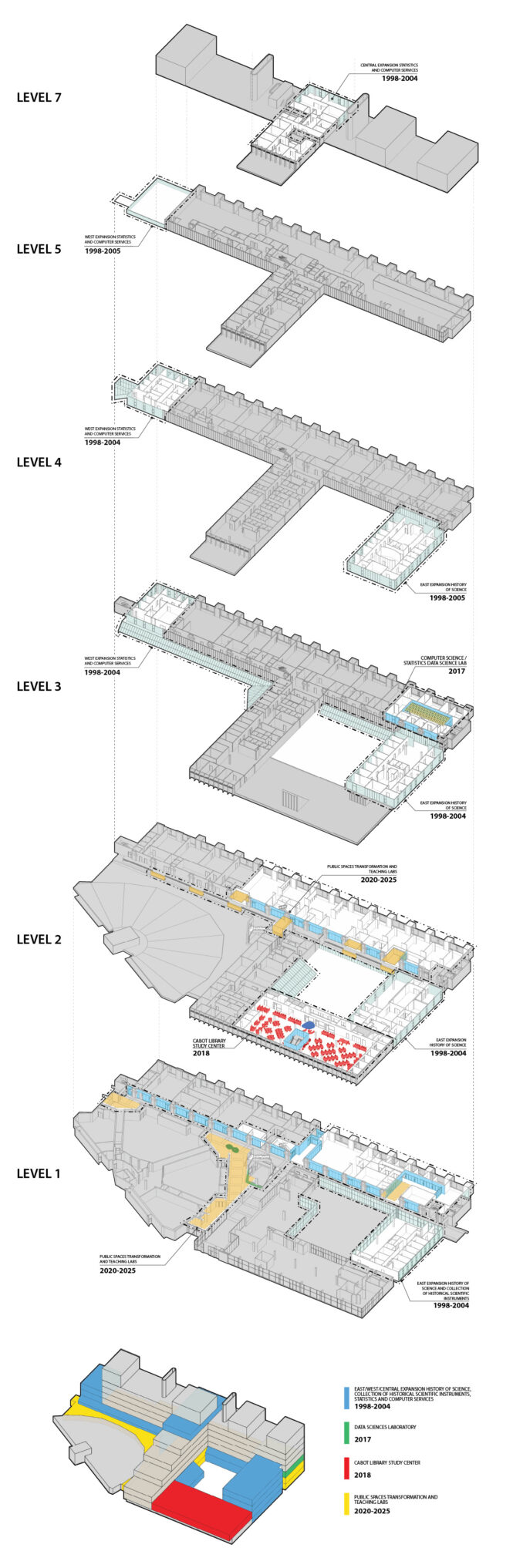
1998-2004 Additions: Expansion of History of Science, Collection of Historical Scientific Instruments, Statistics and Computer Services
By the late 1990’s, the Science Center was rapidly outgrowing its available space, particularly for programs in the Computation, Statistics and History of Science. As the building already occupied its entire site, the only option for additional space was to grow vertically. The three new additions, supported on existing foundations, are light volumes embedded in the solid concrete mass of the building. Energy efficient insulated channel glass echoes the rhythm of precast panels.
2017 Data Sciences Laboratory
A wing of the original laboratory layout was reconfigured to accommodate a research suite for Statistics and Data Science which introduced transparency between the suite and corridor for the first time in the building. The central meeting space is marked by colorful felt acoustic baffles.
2018 Cabot Library, Second Floor
The basement and first floors of Science Center Library were previously transformed by others into a study center with minimal book shelving. We completed the transformation at the second floor by creating a quiet study environment, and restoring the previously enclosed stairway and light well to its open glazed condition bringing light into each of the library’s three floors.
2025 Public Spaces Transformation and Teaching Labs
The goals of the latest transformation were to 1) create an inviting, comfortable, and engaging entry and public experience of the building and 2) reflect current pedagogy and student life which emphasize the social/study nature of learning with the need for diverse places to study individually and in small groups outside of new flexible classrooms and teaching labs.